


In the dramatic power struggle for Angola in 1987, South African Air Force Mirage F1s tackled MiG-23s in the skies above south-western Africa. Lionel Reid recounts the story
Angola 1987. The Soviet and Angolan MPLA forces decided on an ambitious plan: a large-scale assault to finally push UNITA - still the second largest political party in Angola - out of its stronghold in the southeast of the African nation. Cuban allies reluctantly agreed to assist, but with air support only. They knew these actions risked an intervention from the South African Defence Force to support their UNITA allies.
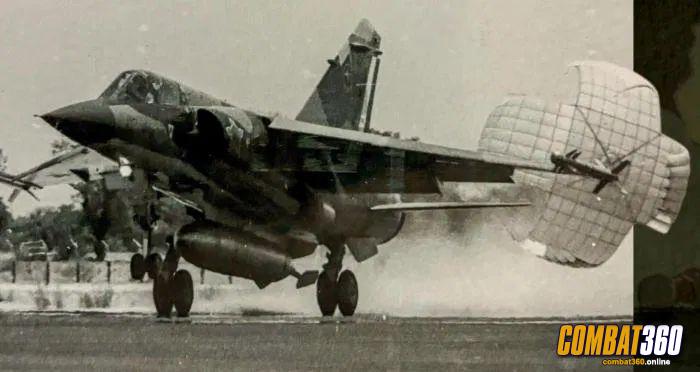
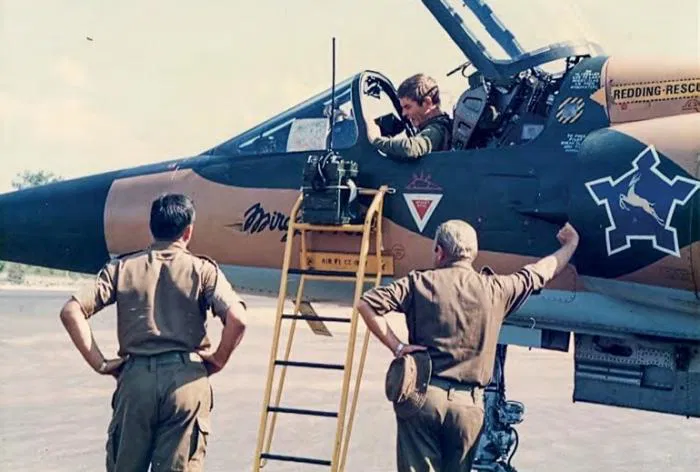
A 3 Squadron Mirage F1CZ touches down at a SAAF forward base in Namibia
The offensive was named Operation Saluting October, honouring the Russian October Revolution of 1917. In July, the Angolan brigades and their Soviet advisors left the municipality of Cuito Cuanavale and advanced towards the killing fields of the Lomba River. They were supported by extensive anti-aircraft defences, including SAM-8s. Control of the sky above the battlefield would become critical.
Since the last air combat in Angola between MiGs and Mirages in 1982, much had changed. MiG-21s were assigned mostly to ground-attack duties, so the principal opponent for the Mirage F1s of the South African Air Force (SAAF) would be the MiG-23ML. A high-powered variant, it had a capable radar system and various missile options including the longer-range R-24. However, the missile that would be key was the highly manoeuvrable, short-range infrared R-60MK.
Previously successful against Cuban-flown MiG-21s, 3 Squadron's Mirage F1CZs were assigned the task of achieving air superiority. However, an arms embargo had limited their air-to-air missile options and they only had the outdated Matra R.550, an older-generation missile with no head-on capability. So the unit had to be creative, as their OC, Carlo Gagiano, explained: "We needed a strategy that minimised our exposure to their superior missiles, decreasing our time in their window. We would head out towards the MiGs at very low level on a vector. When advised by a Telstar airborne link, we would rapidly pitch-up, the element of surprise hopefully nullifying any disparity in radar or missile capability." Pilot Anton van Rensburg noted: "The MiG-23 had a big reputation in Angola, and if we could shoot down just one, it would bring back a bit of balance. Running practice exercises against the Mirage IIIs got us several simulated kills." By September, the offensive was in full swing and some of most ferocious battles on African soil since World War Two were about to take place.
Aerial Tactics
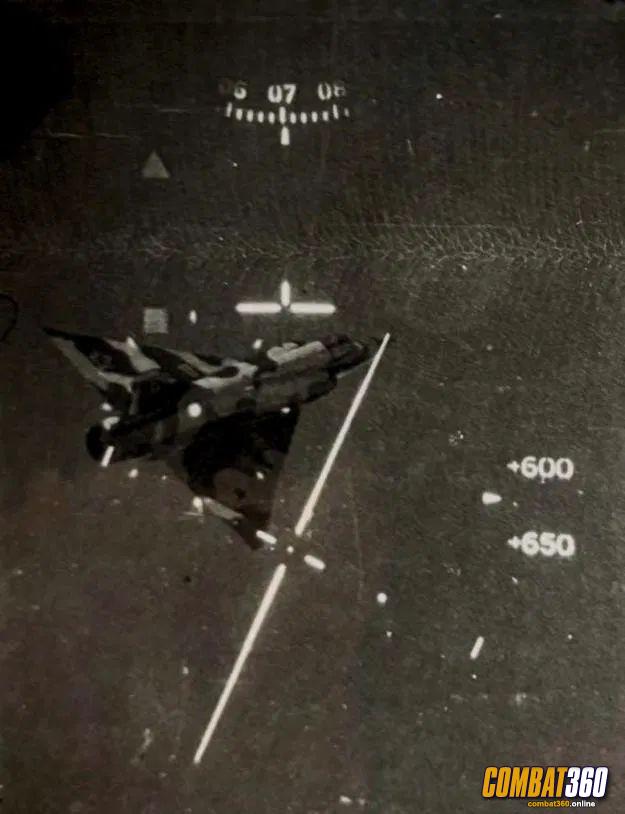
A gun camera shot from a 3 Squadron Mirage F1CZ showing a SAAF Mirage III during a training exercise
On September 4, 3 Squadron SAAF touched down at AFB Rundu in Namibia. Carlo noted that the runway was a bit short: "There were also boulders in the runway overshoot areas. An arrester barrier was supposed to have been installed at the end of the most frequently used easterly runway, but that project had stalled." Safety concerns soon caused tension between pilots and base personnel.
The airspace over the Lomba River would be monitored by the SAAF's Rodent radar system, but it had its limitations, as Carlo revealed: "Our radar coverage of the combat zone only started above 19,000ft. With no cover below that, it was a little like we were headed to a dark hole. There was a distinct possibility that the enemy could keep some MiGs lurking at low level, who could then engage us after our pitch-up."
On September 10, four Mirages scrambled to intercept a flight of MiGs. Carlo led the first pair with Anton as his wingman. Arthur Piercy, who flew as the formation's number four, recalled: "The first pair of Mirages would go out, and two minutes later the second pair. After pitching, the first pair would fly straight through the MiG formation; termed 'blowing through'. Should the MiGs turn to pursue or fight, they would have their tails towards the second pair, making them vulnerable."
As the MiGs broke in opposite directions, Anton quickly outmanoeuvred one of them, launching two missiles. Both missed, the first blowing up just metres behind. "The MiG's acceleration was just unbelievable," Anton marvelled. "We were both going down at about 45° and he quite easily accelerated away from me." The MiGs and their Angolan pilots escaped, but the encounter demonstrated that, correctly executed, the pitch-up attack could catch the enemy unaware. But it also showed that the Mirage was no match for the MiG's raw power and acceleration, as well as confirming the limited capability of the Matra R.550.
As the conflict intensified, SAAF Buccaneer and Mirage strikes resulted in serious Angolan casualties, while two Soviet advisors were seriously injured and one killed. An evacuation by Soviet-flown Mi-17 helicopters was planned for September 27. Convinced the South Africans would intervene, an extensive Cuban MiG-23 combat air patrol was readied.
Showdown
At AFB Rundu, the Mirage pilots were oblivious to these events. Not expecting any action, they were on a relaxed 30-minute standby. Pilot John Sinclair described the scene: "Most of us were lounging around in our shorts, when suddenly the landline rang. Carlo answered and shouted 'Scramble!' We couldn't believe it. It was chaos." With Carlo leading the first pair, wingman Arthur Piercy recalled the scramble: "It was incredibly hot that day and the Rundu runway was short. We used every inch of it to get airborne."
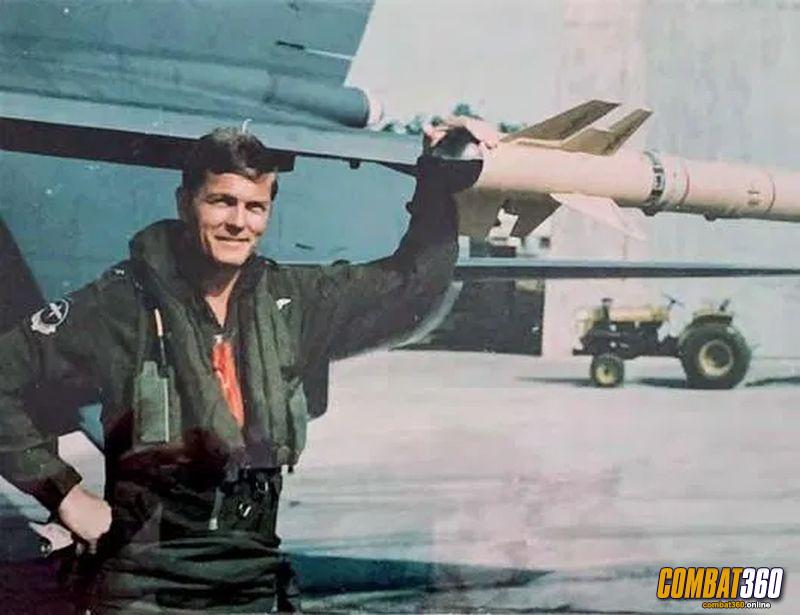
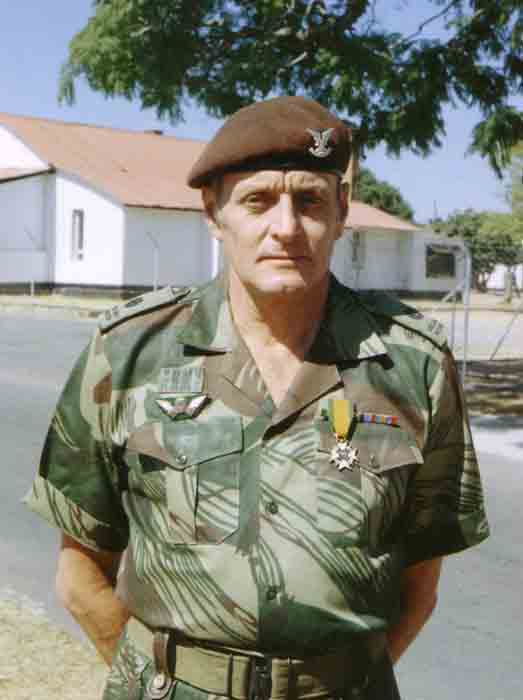
In later years, Carlo Gagiano became a general and Chief of the SAAF
John Sinclair and Frank Tonkin followed two minutes behind. John recalled: "Three pairs of MiGs were reported just north of the Lomba River. We had revised our strategy: our first pair would pitch towards the MiGs and appear on their radar. Hopefully, as these MiGs went offensive, they would be drawn southwards, away from their air defences. Then the first Mirage pair would turn and dive away. Our second pair would then pitch on command, try to pick up these MiGs in the climb and have the chance of engaging them from their rear sector. A third pair of Mirages would be ready to intercept any further MiGs that might pop up." However, their mission was not going to plan: "The Telstar communication link was delayed in getting airborne, and with the Mirages all at low level, we soon lost communications with our radar controller. A few minutes later, communication was established with the Telstar and the first pair was told to pitch."
Enemy radar intercept officer Andrés Feitó saw the Mirages suddenly pop up on his screen, 130km southeast of Cuito. He vectored the closest pair of MiG-23s, led by Major Alberto Ley Rivas, a veteran of two previous Angolan tours, with First Lt Juan Chavez Godoy as his wingman. The two sets of fighters raced towards each other at a combined rate of a mile every three seconds. The MiGs now knew where the Mirages were, but the Mirages did not have the same luxury. Carlo said: "We were at the extreme range of our ground-based radar system. One missed 'paint' meant at least 20 seconds before the next positive position update. At the combined speed of the opponents, the distance travelled in that time is frightening. Our ground radar system started missing paints and we no longer had a clear picture of how far ahead of us the MiGs were."
The Mirage pilots were in an unenviable position. If they turned away, they would expose their rear sector, but if they descended below 18,000ft, they would face the SAM-8s. Carlo said: "We perhaps continued straight for too long, but we had no option but to blow through the MiGs before we could turn. But where were they?" The MiGs now held a clear advantage. Godoy's long-range R-24 missiles had locked on and were ready to launch - the Mirages were right in the missile's kill zone - but he was flying in 'Soviet trail' behind Rivas. If he launched, he might take out his leader. At seven kilometres from the Mirages, he again shouted to Rivas: "Locked on!", but before Rivas could tell him to move out to the beam and take the shot, Godoy called the Mirages visual. The distance had closed so rapidly that the R-24 was no longer an option. It would be a close-range dogfight.
The Mirages were unaware of how close they had come to being picked off. Piercy got the MiGs visual first: "I picked up the lead MiG in my 11 o'clock about a mile away. At that stage I was doing Mach 1.3." Below, Tonkin and Sinclair were still maintaining their low-level vector: "We heard Arthur calling the MiG in sight. This was the point when we should have been pitched by the controller, but nothing happened. Perhaps it was the poor communication link with the Telstar, or maybe the controller who we hadn't really worked with before was used to a different set of tactics."
Despite the frustration, Tonkin made the correct decision not to pitch on their own initiative. At the limit of the ground radar range, the sudden unexpected pitch-up of another pair might have turned the dogfight into total chaos. Racing northwest at nine miles a minute, the window of opportunity to spring the trap was narrowing. Suddenly in front of Sinclair was the Lomba and its SAM-8 defences: "I called Frank and said that the river was ahead, and Frank instantly responded '180° turn. Go!' Suddenly, we were heading south. The chance to pitch up and help Carlo and Arthur had been lost."
Overhead, Piercy watched the MiGs pass between the two Mirages: "The MiG-23 was such an impressive-looking aircraft. As they passed beneath us, they separated vertically from each other during the cross. Their confident positioning made me realise that these were no rookies. Once past them, I called a break to the right. The plan was to bleed the speed down from Mach 1.3 to 480kt during the turn, which would give the best sustained turn rate for the Mirage F1 of 10° per second."
Narrow escape
The MiGs also broke right, but with the jet's rather limited field of view, Rivas soon lost sight of the Mirages. Godoy, sitting further back, had the best view and shouted a continuous stream of advice to his leader. Adrenalin surging, Rivas hauled back on the stick, pulling up to 9Gs in a tight turn. He saw the fuselage of one of the Mirages ahead and above him. It was Piercy's aircraft. Pulling between 4 and 5Gs at this stage,Rivas kept his trigger fully depressed during his turn towards the Mirage, which suddenly came into the launch envelope of the R-60. The missile shot off the belly rail.
Considering the split-second nature of air combat, it isn't surprising that there are some contradictions in opposing accounts. Both Mirage pilots recall the launch coming from when the MiGs were slightly head-on to them - a front-sector launch. However, both Cuban pilots recall the launch angle as being from the rear or side hemisphere.
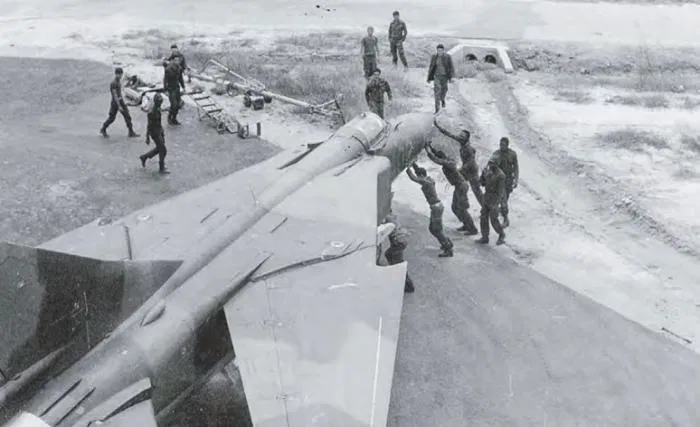
The planform of the MiG-23's variable geometry wing is clearly displayed as Cuban and Angolan ground crew manoeuvre MiG-23ML C-402 into its revetment
What happened next is not in dispute. Piercy said: "As I came around in the turn, I saw the MiG in about my half-past-1 to 2 o'clock position and in a left bank. I realised my Matra would be of no use at this angle, when a missile suddenly launched from the MiG. It had a large smoke trail and was corkscrewing as it came towards me. You are supposed to break towards the missile, which makes it more difficult for it to track you, but it was mentally so tough to follow my training. For a brief second I hesitated, banking the Mirage away from the missile. Then I broke back hard right towards it and watched it flash past over the top of my right-hand wing. As the missile passed behind, I felt a thump. I thought perhaps I had been hit and reported it to Carlo, but all the aircraft indications were normal. Perhaps I had just passed through the missile's wake turbulence."
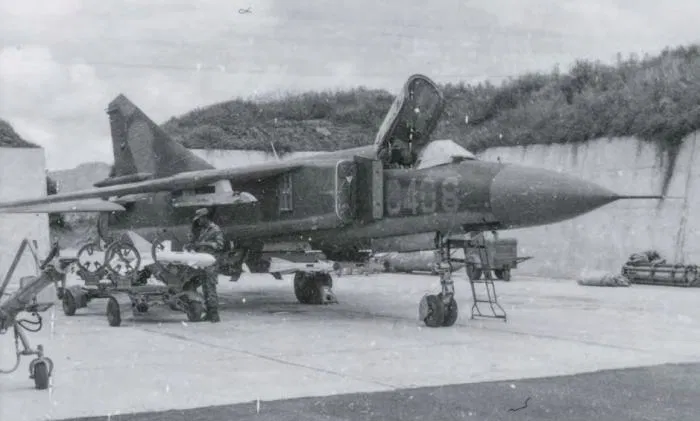
Carlo also saw the missile launch: "As I came out of my turn, I could see the MiGs rolling out of theirs. Suddenly there was the smoke plume of a missile launch from them. My Matras unexpectedly locked onto something and gave their launch tone. I pulled the trigger and the left missile launched. I knew it was completely outside of its tracking parameters, but hoped a missile flashing past them might scare the MiGs. Their missile's smoke plume flashed over my aircraft. Arthur reported that he might have been hit. I told him it was time to get out of the fight." The missile's explosion was hidden from Rivas's view under the nose of his MiG-23, but behind him Godoy shouted: "You got him!". However, it was not a direct hit. The R-60's small explosive warhead allowed Arthur's Mirage to survive the proximity blast, but showered his tail, right stabilator and wing with shrapnel fragments. The critical damage occurred to the complex cold nozzle flaps at the jet exhaust. The Mirages both rolled over and plunged down to safety. Low on fuel, the MiGs couldn't pursue, but were convinced it was a 'kill'.
This plunge was nearly Piercy's final act: "I had not retarded the throttle at all and I was rushing at the ground in a vertical dive. When I pulled the stick into my stomach to pull out, all that initially happened was the aircraft changed its attitude but not direction. The momentum was so great that the aircraft carried on descending. Just when I thought it was the end of me, the aircraft bottomed out just above the trees." Piercy was racing at 700kts just above the ground: "On the deck at those speeds, you get a type of tunnel vision, and I could only see straight ahead as my brain excluded the peripheral details. I just kept going as low and fast as I could." Carlo recalled: "When I finally got Arthur in sight, he was streaming fuel, his rear fuselage peppered with holes and the brake parachute was gone." Multiple emergencies starting to unfold in Piercy's cockpit and Carlo read the checklist actions for him - not an easy exercise at low level and high speed. The first failure was the electro pump of the primary hydraulic system. Then the right-hand fuel pump failed, followed by the second hydraulic system. Then came an impending engine oil pressure failure warning, followed by a low fuel level alert.
Piercy recalled: "Initially, all the emergencies were manageable. My biggest concern was the oil system. The engine would only operate for another 20 minutes before seizing. This wasn't an immediate concern - with all the low-level fuel warnings, I wasn't going to be staying airborne for that long anyway. The more immediate problem was of losing control of the cold flaps on the engine exhaust nozzle, as their actuators were controlled by oil pressure. You then had to use the emergency throttle to control the engine thrust. When the oil had gone, I switched over to the emergency throttle. It is just a blip switch, with a terrible lag. But I still felt that I could safely land with what I had to work with."
Rundu's control tower advised the Mirages that, with almost no wind, the choice of runway was theirs. Carlo noted: "Ejection was one of the options considered, but in the end the decision was made to land. The easterly runway was chosen, as the westerly runway had a hard overrun area with little sand to slow the aircraft down."
Near disaster
Although the easterly runway had no arrester barrier, the pilots had some confidence in the stopping power of the soft sand in the overrun area. However, the first summer rains had fallen just days before. The fierce Namibian sun had evaporated the puddles and baked a firm crust on top of the normally soft sand. Nobody realised the overrun zone had been compromised. Carlo shepherded Piercy onto final approach: "In emergency throttle, the approach speed is around 205kts, which is really fast, especially when combined with having no drag chute and the short runway."
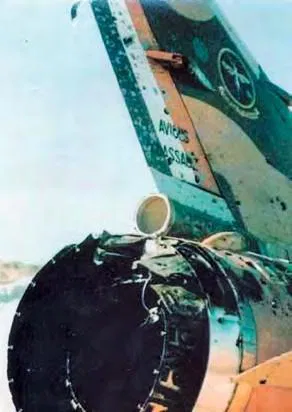
When Carlo Gagiano formed up with Mirage 206 during their return, he advised: "Arthur, you’ve had your tail feathers ruffled."This close-up view shows those 'ruffled feathers'
Piercy was committed to landing - with only partial engine thrust, there was not enough power to abort the landing, nor enough fuel for another approach. He got the Mirage down onto the runway, but the main brakes seemed to have no effect and neither did the emergency brakes. Observers on the flightline saw the tyres burst and it was apparent that an overrun was inevitable. As the Mirage exited the end of the runway, the terrain slanted further downhill and the jet continued on the firm sand crust. It smashed through the base perimeter fence, then the nosewheel hit a boulder and collapsed.
Carlo saw the scene unfold from above: "I caught a brief glimpse of a blurred object pop out of the cockpit, tumble and come to a stop about 20 to 30 metres ahead of the crashed aircraft. The first emergency vehicle reported that the cockpit was empty. I told them to look a few metres ahead of the aircraft. There they found Arthur still strapped to his seat."
The impact of the collapsing nose wheel had caused the cartridge of the Martin Baker ejection seat to propel Arthur out of the cockpit, but the full ejection sequence of the seat wasn't initiated and only the small stabilising drogue chute had deployed. Piercy landed with a sickening crunch still strapped to the seat. His C6 and C7 vertebrae were fractured and, when he woke up, it was to a life in a wheelchair. Today he is still active in many aspects of civil aviation, working as an IT administrator. It turned out the arrester barrier was, in fact, in storage in a hangar at Rundu. The irony was not lost on Carlo: "The barrier that had been such a bone of contention was suddenly set up within days."
However, the Angolan air combat game had changed. All attempts to intercept the MiGs were suspended. Frank Tonkin noted: "The penny had finally dropped at SAAF HQ that intercepting a MiG-23 with our outdated missiles was like taking a knife to a gunfight." Nevertheless, it would not be the last dogfight between MiGs and Mirages in Angola. A few months later, events would show that, in a close quarters dogfight, a skilled knife fighter could at least have a shot at winning.