
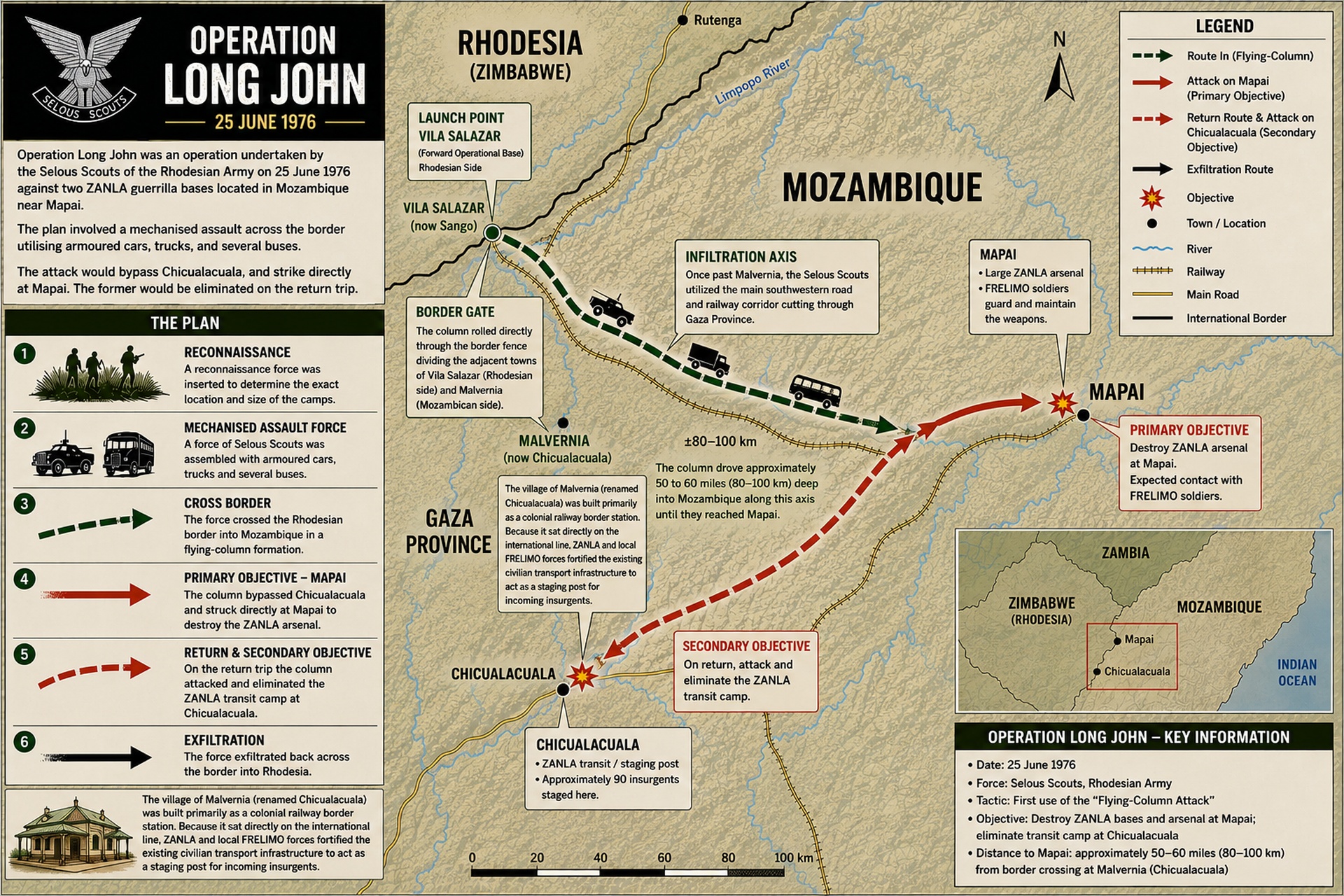
Operation Long John was an operation undertaken by the Selous Scouts of the Rhodesian Army on 25 June 1976 against two ZANLA guerrilla bases located in Mozambique near Mapai. Operation Long John was an attack on a guerrilla transit camp at Mapai and staging post identified as Chicualacuala.
The plan of the operations would involve the first use of a tactic by the Rhodesian Security Forces that would become known as the “Flying-Column Attack”. The transit camp was located approximately 60 kilometres inside Mozambique. It was necessary to introduce a reconnaissance force into the area in order to determine the exact location and size of the camp. It was confirmed that approximately 90 ZANLA insurgents were staged at Chicualacuala, and a large ZANLA arsenal was located at Mapai. The confirmation of an arsenal” meant that the attacking force would come in contact with FRELIMO soldiers of Mozambique.
The new government of Mozambique was willing to provide sanctuary for the Patriotic Front insurgents, but they would not allow them to travel throughout the countryside in armed groups. Their weapons were maintained and guarded by FRELIMO soldiers, and issued immediately prior to their infiltration into Rhodesia.
The plan involved a mechanised assault across the border utilising armoured cars, trucks, and several buses. The attack would bypass Chicualacuala, and strike directly at Mapai. The former would be eliminated on the return trip.
Route and Key Geographic Details
- The Border Gate: The column rolled directly through the border fence dividing the adjacent towns of Vila Salazar (Rhodesian side) and Malvernia (Mozambican side).
- The Infiltration Axis: Once past Malvernia, the Selous Scouts utilized the main southwestern road and railway corridor cutting through Gaza Province.
- The Target Destination: The force drove approximately 50 to 60 miles (80-100 km) deep into Mozambique along this axis until they reached the major ZANLA logistical hub at Mapai
- The Launchpoint: Vila Salazar served as a heavily fortified Rhodesian forward operational base. It featured basic troop bunkers, artillery revetments, and an dirt airstrip situated right up against the international border fence.
- The Transit Axis: The 60-mile (approx. 96 km) stretch of dirt road between the border and Mapai was characterized by dense, low-lying mopane scrubland. This geography restricted the flying column to a single, narrow vehicular lane flanked by the elevated railway berm