
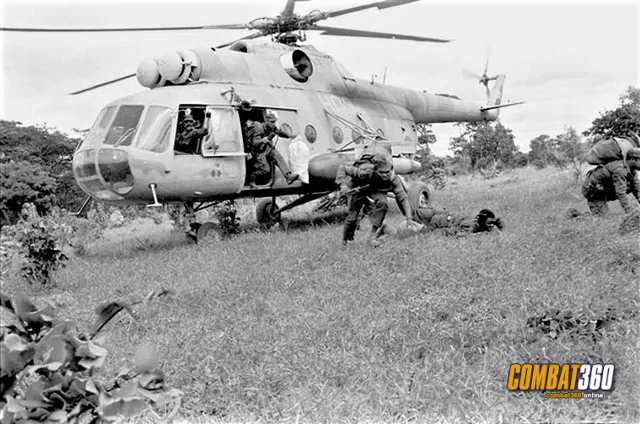
The following account narrates the downing of a Cuban helicopter with 15 people on board, commanded by pilot Emilio González Rivas, on May 17, 1978, Negage, in a confrontation with the FNLA. Commanding a pair of Mi-8 helicopters, we arrived in the afternoon at the village known as Aldeia Viçosa (Quitende), in northeastern Angola (Uíge), more than 200 kilometers from Luanda. Major Fogueton, then the Angolan Military Commander of the region, had gone to his artillery observation post.
The representative of the (Cuban) Air Regiment to the Angolan command, First Lieutenant Jorge Luis, decided to travel in the first helicopter to the previously designated position. The second helicopter was to remain in Aldeia Viçosa awaiting instructions.
We flew to María Adelaida, another nearby town, where we found the Observation Post. At this point, the second helicopter joined us. From there, the enemy positions were quite clear. A mortar belonging to the FNLA was seen harassing the Cuban-FAPLA positions.
Major Fogueton (Angolan) made the decision to strike the enemy using helicopters, although the Cuban military chief, Colonel Harry Villegas (the Pombo of Che Guevara’s guerrilla), was of the opinion that artillery should be used.
We got the impression that the Angolan didn’t like the Cuban commander’s remark, and to justify his decision, he claimed that he only had 29 artillery salvos left, which corresponded to the combat readiness of the unit in question. It was at that moment that we learned of the events in Zaire, but without any opportunity for reflection.
Luanda, May 15, 1978 (PL).- The RPA declared that it is completely uninvolved in any movements by Zairean elements in armed insurrection against the Mobutu government. The RPA noted that the areas identified as the site of the confrontations are not located on the border with Angola.
Lusaka, May 17, 1978 (PL).- British Foreign Secretary David Owen told Parliament that there is no evidence to prove foreign involvement in the fighting taking place in Zaire.
We should never have accepted the plan to strike head-on against an enemy who was aware of our position and had surely developed plans to counter our presence. The lead helicopter attacked the mortar position, passing over the front line at 400 meters high, while the second helicopter was to provide the necessary cover by flying at 800 meters altitude.
As we flew over what was considered the enemy’s leading edge, we heard that they were firing at us. We ordered the infantry weapons to be fired by the personnel who were in the cargo cabin. The second helicopter, instead of maintaining the coordinated altitude, stayed at the same flight level as the lead helicopter.
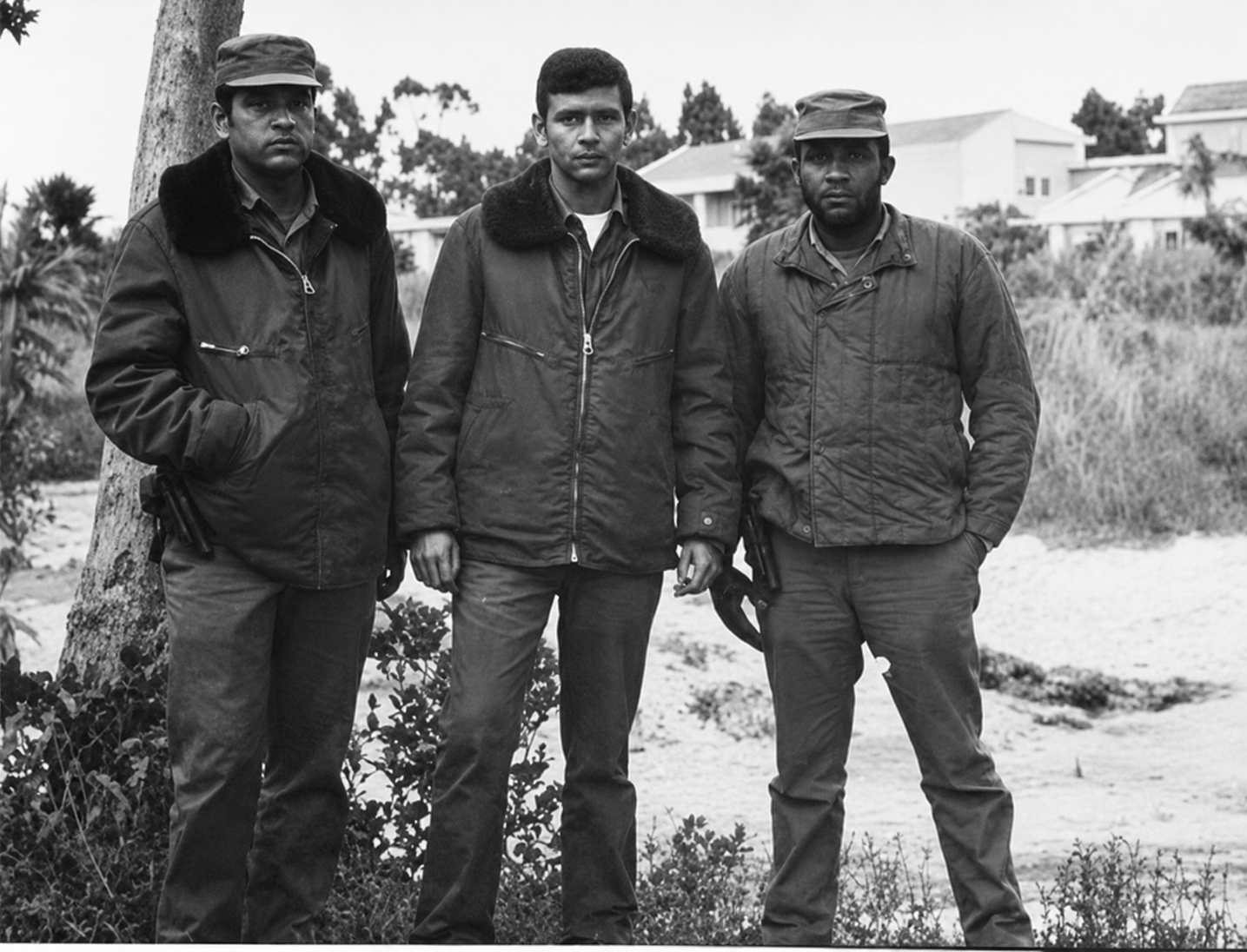
From left to right, Silvio González Mojena, Mario Riva Morales and Emilio González Rivas (killed in combat)
We assumed that, being at a distance of one kilometer, Emilio González and co-pilot Juan Valdespino, the crew of the second helicopter, could have seen the place from which the shots came, and that is why we asked them the standard question, and upon receiving the affirmative answer we ordered them to enter combat and use the rockets.
Leaving the combat area, we observed a flare on the left side of Emilio’s helicopter, between the inner edge of the rocket block and the left fuel tank, directly above the left main wheel.
Emilio answered affirmatively to our question about whether he knew the helicopter was on fire, so we ordered him to land on the first available platform. But Emilio’s helicopter didn’t enter autorotation, which is the correct procedure for this type of emergency, but instead began to perform level turns.
That agony lasted six minutes because, apparently, Emilio’s indecision allowed the fire to intensify, forcing the crew members inside the cargo hold to move toward the front of the cabin. This destabilized the helicopter until, pressured by the flames, many of those trapped inside decided to jump from the aircraft rather than be burned alive. We saw three of them, holding hands, leap into the void.
It was like a horror movie, on a widescreen, full-color display. Only the smell made us realize it was real, that we weren’t in a movie theater. After four or five minutes, Emilio approached a platform on a mountain peak, stopping just below it.
We immediately noticed the loss of control over the flight parameters and how it was plummeting towards the ground in a ravine. We landed three times to search for our companions, but the dense jungle in these areas prevented any rescue attempt.
On the penultimate occasion when we managed to land on the summit of one of the hills closest to the crash site, Colonel Harry Villegas, who was aboard our helicopter, ordered the infantry squad (nine men from his escort) to disembark and go to the spot where the rockets from the downed helicopter were exploding at that very moment. The squad leader hesitated, and noticing this, Villegas jumped out of the helicopter shouting something like, “Everyone with me!” and they disappeared down the slope.
Realizing the immense responsibility we would bear should anything happen to Villegas, we ordered the co-pilot (Oscar Machado Hernández) to bring Villegas back to the helicopter, no matter what. The enemy could attack our position with mortar fire, and if we were forced to take off, they would be isolated on the opposite bank (from our troops’ position) of the Dange River.
By this time Machado had managed to establish communication via shortwave radio with Luanda and Marcos Cairo, the Chief of Staff of the Air Regiment, who was trying to provide support with combat aircraft.
The planes flew overhead and we could see them, but they never saw us. The poor visibility prevented them from assessing the terrain. Nevertheless, we felt protected and grateful. At least we knew we had company.
The time had come to decide to leave the scene. Night was falling, and only the fuel reserve remained, enough to return to Negage airfield, when, from the air and on our last pass over the crash site, we spotted Rodolfo Castillo, the flight technician of the ill-fated crew, and a soldier from the FAPLA (Armed Forces of the Argentine Air Force).
With a fractured collarbone and a deep wound on the back of his head, Castillo had managed to reach the summit and was signaling with a white t-shirt. We managed to land and rescue him; however, the FAPLA soldier never reached the helicopter. Castillo later reported that after they separated on the final stretch, he never saw him again.
The next day we arrived at the disaster site quite late, around 11:00 a.m. The clouds, skimming the peaks of the highest mountains, did not give us the opportunity to locate the position, much less attempt a landing in those weather conditions.
We finally managed to recover the bodies of our comrades, almost all of them tortured (those who were still alive when the FNLA troops arrived), and those who were already dead had had their genitals mutilated. The resentment and hatred were immeasurable. War unleashes the lowest instincts of human beings.
The Commission investigating the events tried to present the downing of Emilio’s crew as an accident, the result of a piloting error, which we categorically opposed.
This commission was composed of Colonel Ernesto de la Paz Palomo (he doesn’t like to be called by his second surname), inspector of fighter aviation**, Lieutenant Colonel Miguel Luna, chief engineer for helicopter aviation and Lieutenant Colonel Lezcay, Head of the Aeronautical Medicine Laboratory.
In the early hours of May 19, 1978, the second day after the catastrophe, we were writing the report of the events when, followed by a loud explosion, the roof of the building where we were located collapsed above our heads. Luna’s face was bleeding, and he was gesturing wildly, pistol in hand. Machado, the helicopter’s co-pilot, was shouting “mortars.”
Some mercury fuses had exploded; they had been carelessly left in Colonel Villegas’s office inside a can being used as an ashtray by one of the men gathered there. This oversight cost Villegas dearly: a shard lodged in his testicle. The smoker lost a finger.
The conclusions of the investigating commission did not coincide with the opinions of the surviving crew. I must emphasize that no helicopter pilot was present on this commission, nor even an officer with tactical training in this type of weaponry. Only an engine and airframe engineer was present, who, unfortunately, could contribute nothing more than his technical knowledge.
Responsibility for the deaths of 15 colleagues, who were aboard the helicopter, could have been attributed to the…
- Lack of information on the real situation of the FNLA in the region.
- Lack of close cooperation between the different types of weapons present in the theater of military operations.
- Lack of knowledge on the part of the Military Chief of the region, regarding the role that helicopters should play.
Incredibly, everything was left in limbo. We had been sent to operate under the command of FAPLA, something truly unusual, because according to the regulations of the Head of the Cuban Military Mission in Angola (MMCA), such operations were completely prohibited.
When José Antonio Alvarez Lachiondo, the Head of the Air Regiment, had ordered us to submit to the orders of the FAPLA Command, we managed to get him to issue an authorization, signed in his own handwriting; but more than that, we had managed to get him to send an aviation representative to the head of the detachment.
This document, plus the fact that I was not directly in charge of the operation, helped to prevent the rope from breaking at its weakest point, although we know that Brigadier General Rubén Martínez Puentes (at that time a sub-captain), who would later become Chief of the DAAFAR Troops in Cuba, and who was in the RPA in charge of a Control Commission, tried unsuccessfully to blame us for the catastrophe.
Marcos Cairo (Chief of Staff of the Air Regiment), confidentially told us that Martínez Puentes had asked him if we hadn’t been stupid. After Emilio’s death, and after a prisoner’s confession allowed us to detect an FNLA operations base, the Cuban military command planned a response operation.