
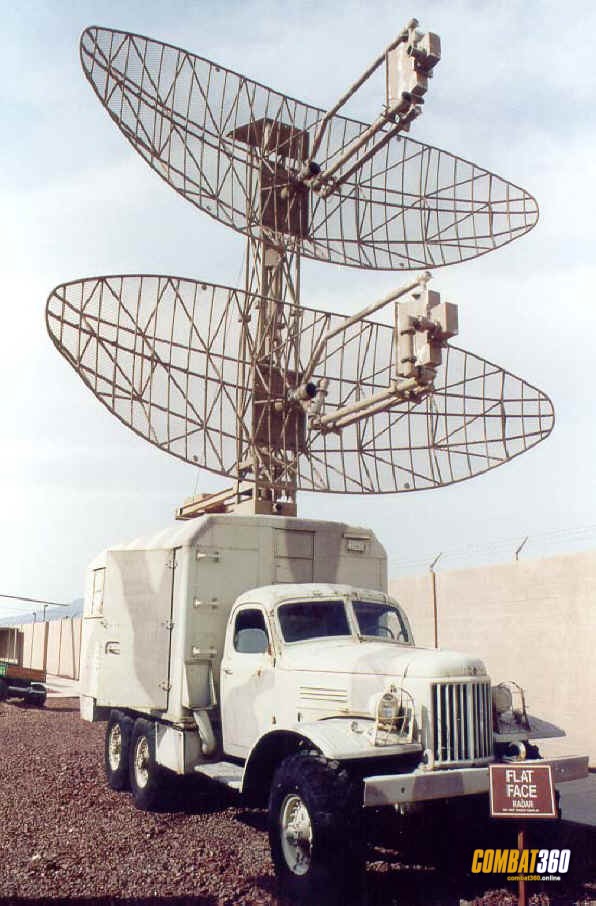
The P-15 “Tropa” (GRAU designation 1RL13, NATO reporting name “Flat Face A”) is a mobile 2D UHF early warning and target acquisition radar developed by the Soviet Union in the 1950s. It was designed specifically to detect low-flying aircraft and provide target data for surface-to-air missile batteries. During the Angolan Civil War and the South African Border War, the Soviet-supplied P-15 “Flat Face” radar served as a primary target acquisition and early warning sensor for the Angolan government forces (FAPLA) and their Cuban allies. Deployed across southern Angola starting in the early 1980s, it formed a critical link in an integrated air defense network designed to challenge the South African Air Force (SAAF).
Technical Role & Specifications
- System Function. The P-15 “Tropa” (NATO reporting name “Flat Face A”) is a mobile, 2D UHF target acquisition radar mounted on a ZiL-157 or ZiL-131 truck. It features two distinctive stacked elliptical parabolic antennas that can be deployed or packed away in under ten minutes.
- Detection Capabilities. Operating in the UHF band, the radar had a maximum detection range of roughly 150 to 250 kilometers. It provided azimuth data while working alongside PRV-11 “Side Net” height-finding radars to track aircraft altitude.
- Missile & Fighter Integration. In Angola, P-15 units were paired with S-125 Neva/Pechora (SA-3 “Goa”) and 2K12 Kub (SA-6 “Gainful”) surface-to-air missile batteries. They also fed tracking data to ground-controlled interception (GCI) centers to vector Angolan and Cuban MiG-21 and MiG-23 fighters.
Deployment in Southern Angola
- The “Zigzag” Radar Line. By the early 1980s, Soviet advisors helped establish a strategic radar screen along the Namibe-Menongue railway line. P-15 radars were stationed at key hubs including Namibe, Lubango, Menongue, Cahama, and Cuito Cuanavale.
- Tactical Impact on the SAAF. The introduction of the P-15 and long-range P-18 “Spoon Rest” radars stripped SAAF strike aircraft of the element of surprise during cross-border operations from Namibia. South African pilots were forced to fly at ultra-low altitudes to stay below the radar horizon and adopt “toss-bombing” tactics to avoid missile engagement zones.
SADF Countermeasures & Captures
- Electronic Warfare & Intelligence. Neutralizing and studying Soviet radar installations became a high priority for the South African Defence Force (SADF) and Western intelligence agencies. The SAAF deployed specialized electronic intelligence aircraft, such as the modified C-47/DC-4 “Spook,” to map the frequencies and locations of P-15 sites.
- Battlefield Captures. During major ground incursions, SADF and UNITA forces actively targeted air defense assets. Notably, following the Battle of the Lomba River in October 1987 during Operation Modular, South African forces recovered an intact “Flat Face” radar alongside an SA-8 Gecko system, providing valuable technical intelligence on Soviet air defense capabilities.