


In Angola during January 1986, Cuban intelligence services received reports from near the city of Huambo that many local village women were using parachute material to wrap their infants onto their backs. Rebel leader Jonas Savimbi and his National Union for the Total Independence of Angola (UNITA) had a strong presence in the area, and it seemed somebody was making parachute cargo drops to supply these guerrillas.
The culprit turned out to be the South African Air Force (SAAF) - and 28 Squadron's Lockheed C-130 Hercules crews had built up considerable experience in the clandestine skills of low-level night-time supply drops in Angola. The Cubans wanted to put an end to these drops and planned a trap.
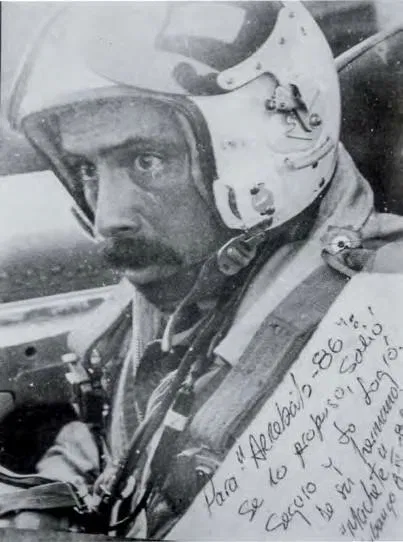
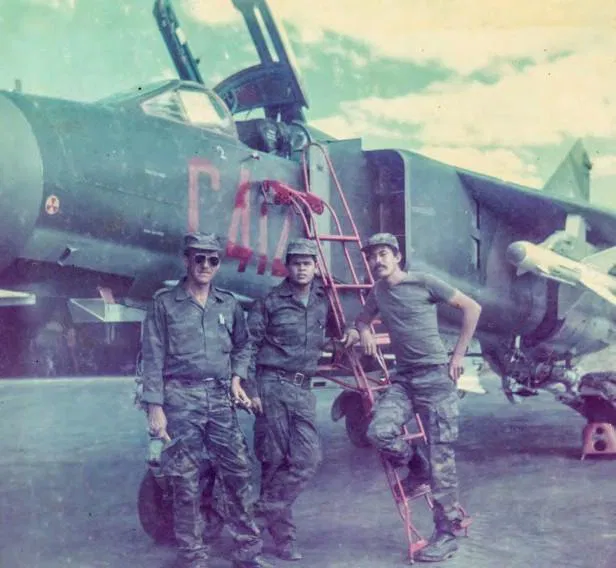
Eduardo Gonzalez about to depart on a MiG-23 combat sortie in Angola in 1986. Cuban war correspondent Milton Diaz captured the intensity of the upcoming mission in Eduardo's expression
The terrain to the north of Huambo had high mountainous ridges, an ideal location for a mobile radar station to monitor the suspected area. A site approximately 160km northeast of Huambo near the town of Andulo was chosen, and a convoy of vehicles was despatched to set things up. As of 1986, South African support for UNITA was supposed to be covert and fell to a special branch of the Military Intelligence Division. These South African intelligence services never got wind of the Cuban ambush plans.
Once the challenge of setting up the radar station had been overcome, training commenced, with radar controllers working in tandem with MiG-23 pilots to fine-tune the dark art of low-level night intercepts. Maj Eduardo Gonzalez, the commander of the Cuban MiG-23 squadron, was placed in charge of the task. The nocturnal visitors preferred to operate when the moon was in its darkest phases. By late March, there was an element of time pressure, with the full moon rising on the 26th, and supply drops likely to begin shortly after as it began to wane. Final preparations began, and a pair of MiG-23MLs was ferried from Lubango to Huambo.
By April 3, 1986 the moon reduced to a waning crescent and the MiG pilots settled down to night standby in a van parked next to their aircraft. Their sleep went uninterrupted, but the following night would be very different.
Nocturnal mission
On April 4, moon conditions were dark enough for the SAAF to resume night operations. A supply drop was planned for just west of the small town of Calucinga, within 70km of the new Cuban radar station.
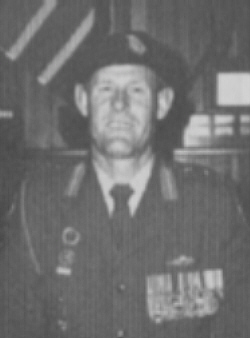
At 14h30 GMT, two Hercules C-130Bs took off from Waterkloof and headed for AFB Grootfontein. In the lead was Hercules 401, with Capt Marc Bignoux operating his first flight as commander in the specialised art of night-time supply drops. He would be under supervision, with instructor Maj Adrian Woodley, a veteran of many drops, sitting alongside. Lead navigator was Maj Dave Rouse.
The commander of Hercules 402 would also be under supervision. Capt Russell Espley Jones was being checked out by Cmdt Bob Hewetson. Their lead navigator was Capt Anton Knoetze, with Maj Tobie du Toit assisting, and Flt Sgt Rassie Erasmus as flight engineer. That night the loaded C-130s departed Grootfontein.
"We regularly flew these supply drops deep into Angola and Mozambique," explained Marc Bignoux. "That night it seemed to be just another drop. Just before crossing into Angola, we would move from a loose formation into a more tactical one, about 0.2 to 0.3 nautical miles apart. We used the air-to-air TACAN for our spacing and would ideally fly at about 500ft above the ground. The navigators were brilliant and instructed us when to climb, descend, the headings to take up etc. Of course, these were the days before GPS. The lead aircraft would maintain consistent basic parameters for the number two aircraft to fly around. They would take up a position just back from abeam the lead and about 20 to 30ft higher. Night formation flying could be tricky and took some time to master."
This slightly elevated position allowed the pilot flying formation to see the purple formation lights on top of the lead aircraft through his lower side windows.
As the C-130s headed north, Eduardo Gonzalez and Capt 'Pancho' Doval oversaw the final preparations on their MiGs in Huambo. Eduardo opted for a belly tank and two R-24 missiles on the wing pylons: an R-24R and an R-24T. A large, imposing missile packing a lethal 35kg warhead, it came in two variants: the semi-active radar homing R and the infrared T. The former was purely radar-guided, requiring the launch aircraft to keep a radar lock on the target until impact. The R-24T relied on the infrared thermal signature of the target. Once launched it was independent of any aircraft system, homing in with its own infrared head.
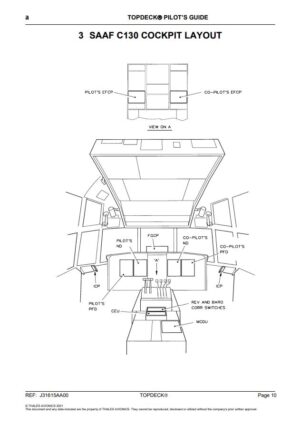
The drop zone (DZ) that night created certain challenges for the C-130 crews. The area just south of the DZ is mountainous, preventing direct routing from the south. Instead, the formation would need to curve west around the high ground to eventually approach the DZ from the north-east.
During the war, the SAAF had minimal access to detailed aviation maps of Angola; the C-130 navigators thus relied on 1:1,000,000 scale ONCs (Operational Navigation Charts) bought from overseas. Large portions of these maps had little detail. Dave Rouse explained the problem: "With little or no moon, you could sometimes navigate by the light of the stars, but if a little bit of cloud came along, that would also be gone. So, the night was about as dark as the inside of a cow, and you were flying along in a mountainous area with a map you didn't trust! We always tried to vary our routes, but on this occasion, we had no choice but to fly the same route to and from the drop zone."
As Dave and Anton gave the pilots the new headings to start curving west around the high ground, the Andulo radar station picked up their radar signatures. The game was on.
MiG scramble
Eduardo was sitting in the standby van when the call came to scramble. He would fly as a singleton, Doval remaining on the ground on standby. Once airborne, he immediately turned north.
Unaware of the commotion at Huambo, the C-130B’s continued towards the well prepared DZ, with the marker fires readily visible from the air. The drop used the Platform Load Extraction Delivery System (PLEDS). Rassie Erasmus, a veteran of these drops, described the busy scene in the cargo hold: "The pallet configuration could vary from between one to three pallets, differing in size and weight; they sat on a honeycomb base that cushioned its landing. Each had a single extraction parachute, between 15 and 28ft in diameter, depending on the load. The huge round main canopies could be anywhere between 60 and 100ft in diameter, and the number of chutes per pallet would vary from three to six, depending on the weight.
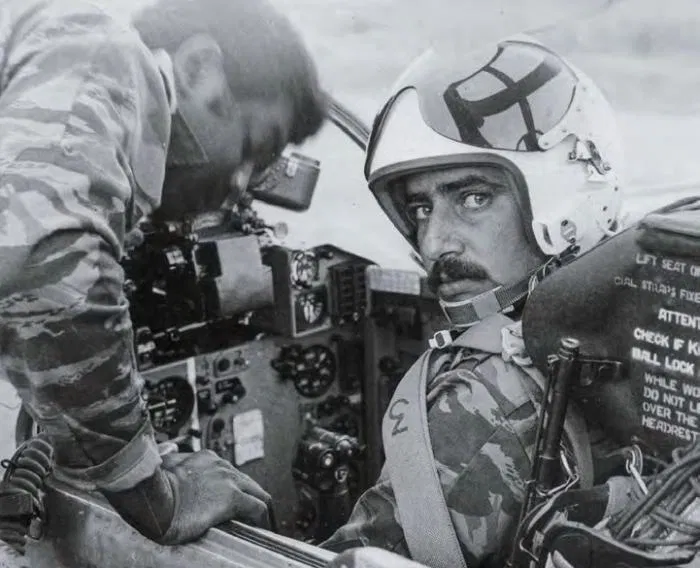
Capt Raul Rubio strapping into the front seat of a MiG-23UB for a night-training flight during March 1986
"Facing to the rear of the aircraft, on the right-hand side of the pallets, were rigid locks, while the locks on the left-hand side could be set to a pre-determined tension that would allow the force of the extraction chute to pull the pallet out of the aircraft. At the six-minute warning, the front drop-master would pump out all the rigid locks, while the rear drop-master opened the ramp at the back. Now the pallets were 'hot' it was scary looking out into this dark hole at night. If there were mistakes, there was going to be blood - our blood."
"Before the DZ, we would space to line astern," explained Marc. "Turning on final approach, we would slow down to 135kts. After hours of flying in the dark, the DZ fires could seem blinding. Just before we reached the fires, we would begin the drop."
Rassie described the drop: "The first pallet's extraction chute was released. As it hit the airstream, all hell would break loose. The adjustable locks on the cargo pallets pulled free and the freight began to run. The first pallet had the extraction chute for the second pallet attached to it, so they pulled each other out in turn. The sequence became unstoppable, much like a mini freight train. The last pallet reaches a tremendous speed and creates a vacuum in your ears. The noise and dust is incredible and above it all, the crack of the main parachutes pulling open. Moving back to close the ramp, you could see the descending pallets silhouetted against the DZ fires."
Adrian Woodley was well aware of the challenges: "As all the pallets raced backwards, it resulted in a sudden and large shift in the C-130's centre of gravity. This caused the nose to pitch up quite strongly; in fact, you had to jam the control yoke right forward against the dash. Just as you became really concerned about the nose-up pitch attitude, the load exited the aircraft, which then abruptly pitched forward and down again. A pallet getting stuck would have been an unrecoverable disaster."
The drop completed, the C-130s headed back north-east. It seemed the most stressful part of the evening was over. It wasn't.
In for the kill
In the dim glow of the cockpit, Eduardo focused as he raced north-east. The excited voice of radar controller Perovanis greeted him: "Five twenty, heading three-five-zero, maximum speed. Two targets at a height of 900m."
The MiG was in maximum dry thrust. Not picking anything up on his radar yet, Eduardo began a slight descent towards 2,000m. At a similar altitude to that of the intruders, it would be easier for his radar to pick them up. Cutting through the darkness at just over 1,000km/h and still accelerating, everything felt surreal.
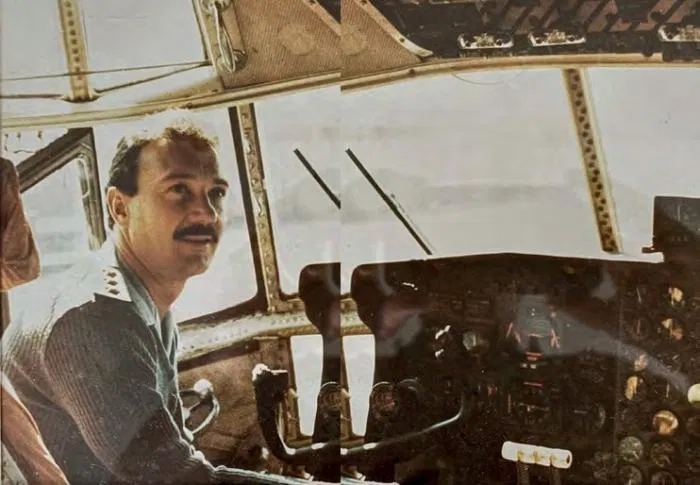
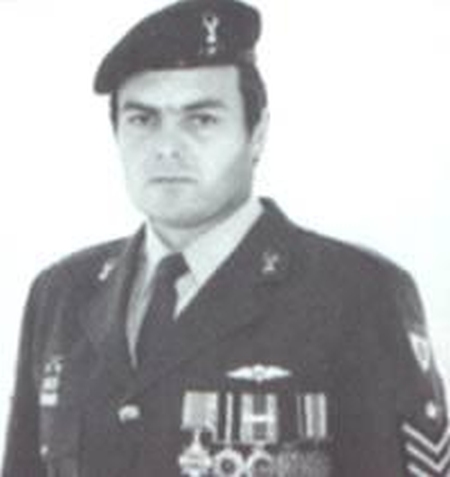
Capt Marc Bignoux sitting in the commander seat of a 28 Squadron C-130B in 1986
In the number two C-130, Russell caught up to the lead Herc after the drop. "All we had was a distance readout on the air-to-air TACAN," he said. "The lead would fly at a groundspeed of 250kts, and we flew the same track but at a higher groundspeed, until we could see his lights."
The C-130B’s suddenly popped up on Eduardo's radar at 35km. He locked onto the closest blip and at 25km to the target, he was cleared to fire. With the head of the R-24R missile receiving the target's co-ordinates, the message launch permitted came up on the HUD. He pulled the trigger.
"Hold on… It's not there! You got him!" came the excited reply.
However, the explosion had not been an entirely convincing one, creating doubt in Eduardo's mind. Perhaps the explosion was the missile impacting one of the hills or ridges in the area. And perhaps these same ridges were what suddenly shielded the C-130 from their radar screens. The missile must have exploded some distance behind the C-130, because the crew never saw it pass them.
So, completely oblivious to the pair of excited Cubans trying to kill them, the C-130s continued northeast, their flight tracks diverging away from Eduardo as he broke off to the right. But the night still had another twist to come.
Close call
Eduardo's radio suddenly came to life again. "Five twenty, the other target is on the screen! Turn left thirty degrees. Distance Thirty. Maximum speed!"
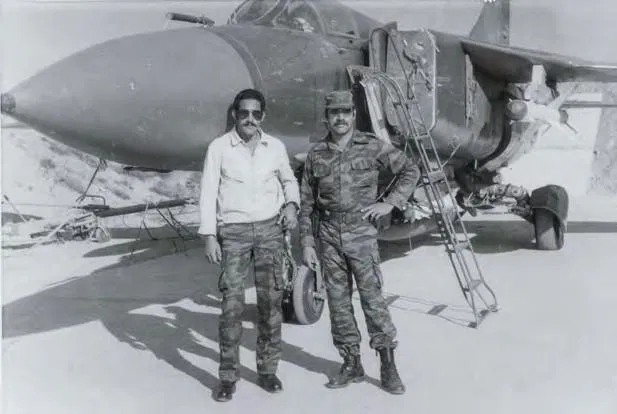
MiG-23 pilot Lino Vieras (left) and a Cuban intelligence officer next to a MiG-23ML at Huambo in April 1986. An R-24T missile is loaded on the jet's left shoulder pylon
Eduardo jettisoned the empty belly tank and applied afterburner as he swept the wings fully back, soon he was above Mach 1. Perovanis gave a warning to watch his height, as he was in the vicinity of some high ground. He came out of afterburner, a quick glance at his speed: Mach 1.3 and slowly reducing.
Descending through 1,500m, the target was still not visible on his display. Once below this altitude, the MiG's radar uses the Doppler shift principle to paint any target that is moving, thus minimising ground return. He was closing in rapidly on the C-130 and couldn't afford to overshoot it. Not wanting to wait for the radar to go through its full search sequence, he tried a shortcut setting the radar search area to 15km ahead, which was where the C-130 should be, and pressed the lock on button. Almost straight away, a cross and a ring appeared on his display - the radar had acquired the new target.
Eduardo's radar was sending the information to the thermal seeker head of the R-24T this time. But the C-130's design makes it a difficult low-level target for an infrared-equipped foe. The turbine outlets of its turboprop engines are positioned underneath the wings, shielding the engine's heat signature from an opponent at higher altitude. To get an effective lock-on, the infrared missile needs a launch platform that is preferably slightly lower than the C-130. Getting there was risky.
The C-130s were approximately 400m apart, with no idea that a MiG had locked onto them. An amber light illuminated near the base of Eduardo's gunsight, indicating that the thermal head of the R-24T had located the heat source and the missile confirmed its readiness. At a height of 300m and speed of 1,150km/h, the distance closed to 5km, basically point-blank for an R-24. He pulled the trigger. The missile left its rail almost immediately, now autonomous as it streaked away tracking the C-130's heat signature.
Eduardo's situational awareness came into sharp focus; not wanting to become one with the mountains around Andulo, he pulled back the stick, losing sight of the missile underneath the nose as he climbed.
The sheer kinetic energy of a 240kg missile moving at Mach 3.5 generates a significant shockwave, as the Hercules crews were about to discover. "Marc was flying, and as I looked outside, I noticed what I thought was a flare, maybe one mile off to our right, and moving in the same direction as us," Adrian recalled. "It had a flat trajectory with a slight arc to it and wasn't particularly fast. It disappeared, as I turned my head to tell the other guys what I'd just seen, the whole side of the cockpit was lit up by this bright green glow and a missile shot past us. It was climbing slightly, travelling extremely fast, and rapidly got smaller and disappeared out of sight. It was really close, passing between the two props on the left. We felt the impact of the missile's shockwave. It unsettled the whole aircraft. I thought we had been hit by something."
Marc: "We were snapped wide-awake in a split second, momentarily blinded by the bright glare, and the cockpit filled with the smell of what must have been missile fumes. There may well have been some other fumes suddenly filling the cockpit as well! Adrian told me, 'Go down!'"
Dave Rouse was in the navigator's seat behind Adrian and Marc: "I said, 'I think we've been hit.' We turned right and descended sharply, well below what I considered to be the safety altitude for the area. I hoped the two pilots sitting in front would have far better night vision than I did. I just kept on reading out the radio altitudes. We levelled off at low level, and after a few minutes climbed back to what I considered a safer altitude. The other C-130 had disappeared."
Russell in Hercules 402 remembered the missile obliterating the calm on their flight deck: "It came belting past. First, I saw this flash, then felt a bang from the sonic boom. Apparently, the guys tidying up in the cargo hold were knocked off their feet. I watched the missile carry on straight."
Navigator Anton had a message for the pilot who stalked him all those years ago: "Listen, when you do speak to Eduardo again, please tell him that he owes me a new pair of underpants!"
Failure most fortunate
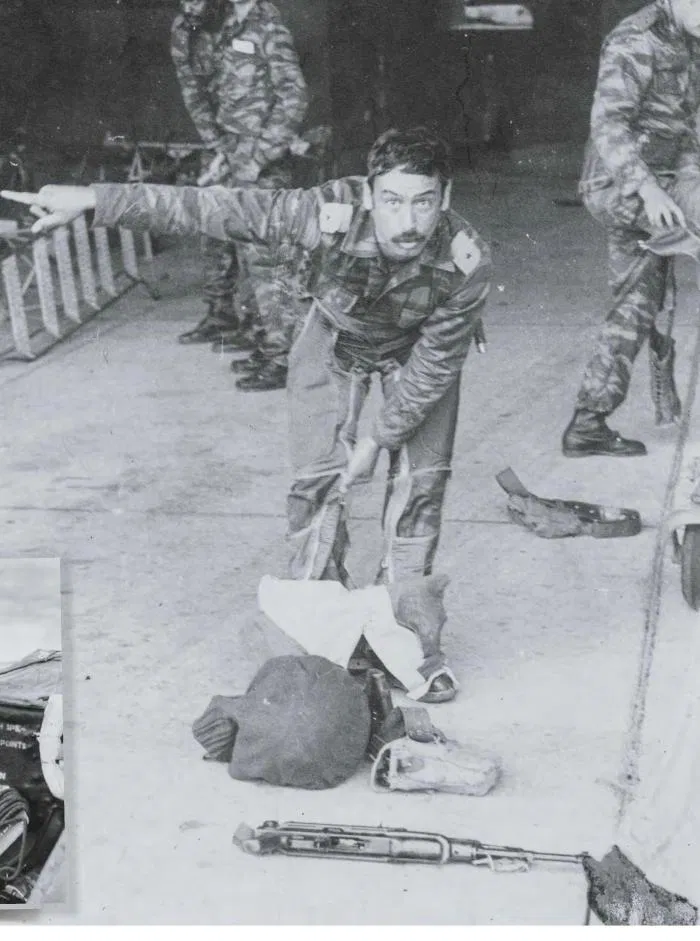
Lubango, March 1986. Maj Eduardo Gonzalez directing preparations for the MiG-23 ferry flights from Lubango to Huambo, to position for the C-130 interception missions
Eduardo had broken off from the attack without seeing any explosion from his missile. The C-130 blips popped up on the Andulo radar again and Doval was scrambled to try to cut off the south-bound intruders. He raced to the last known position but the C-130s were gone.
Hercules 402 performed a pressurisation check, and with no evidence of damage, continued to Waterkloof. Hercules 401 made a precautionary diversion to Rundu for a damage check, before continuing on to Waterkloof. The post-flight inspection showed just how close the missile had passed. "When we inspected the aircraft you could see that something had burnt into the paint; it had these little dots," said Dave. "We surmised that it could have been particles from the rocket motor engine burning the paint as it passed us."
Later, Rassie also saw these marks: "They were little spots down the bottom of the aircraft, like small welding spots hanging onto its belly."
The proximity fuse of the R-24 is designed to detonate once within eight metres of the heat source. This missile had passed closer than that. When one considers the full extent of the journey of the missile, with its complex electronics, from the USSR to Huambo - first by ship, then by convoy along winding and terrible roads - its failure is less surprising. The C-130 crews had nevertheless used up a lifetime's worth of luck in one night.
In the days that followed, the Angolan press reported that at least one C-130, perhaps more, had been shot down. The SAAF denied it and of course denied ever being there.
Victor Zazeraj was private secretary to South Africa's Minister of Foreign Affairs Pik Botha at the time of the incident and summed it up decades later: "In any war there are certain events that are game changers. This would have been one of them. If a SAAF C-130 - or worse, two - had been shot down deep in Angola, it would have fundamentally altered things and destroyed our credibility as the Department of Foreign Affairs. In diplomacy, your credibility is everything."
In the SAAF debriefs that followed, HQ came to the conclusion that it was most probably an SA-2 surface-toair missile that narrowly missed - and the resupply flights continued, but to different areas. The possibility that it was an air-to-air missile was never really considered; the complete story would only emerge decades later.
In May 2019, with Marc Bignoux as the driving force, it was arranged that Eduardo would fly out to South Africa to meet his erstwhile victims. The 'debrief' took place at a pub close to Johannesburg. Eight C-130 crew members from that starry night managed to attend - Marc, Adrian Woodley, Dave Rouse, Louis van Wyk, Russell Espley Jones, Tobie du Toit, Anton Knoetze and Rassie Erasmus all had a chance to share a drink with Eduardo.
The get-together lasted 12 hours. Maps were studied and stories shared, the camaraderie of former enemies cutting across all political or ideological boundaries. During a day of many beers and even more jokes, the nine men were able to recreate a complete version of events for the first time.
As a fighter pilot, Eduardo always hoped to score a 'kill' - of the aircraft, that is, and not necessarily the people inside. It is, after all, the purpose for which he trained. In the years after the war, he often felt some frustration that the missile had failed - but decades later, now good friends with some of those C-130 crew, he considers it a failure most fortunate